
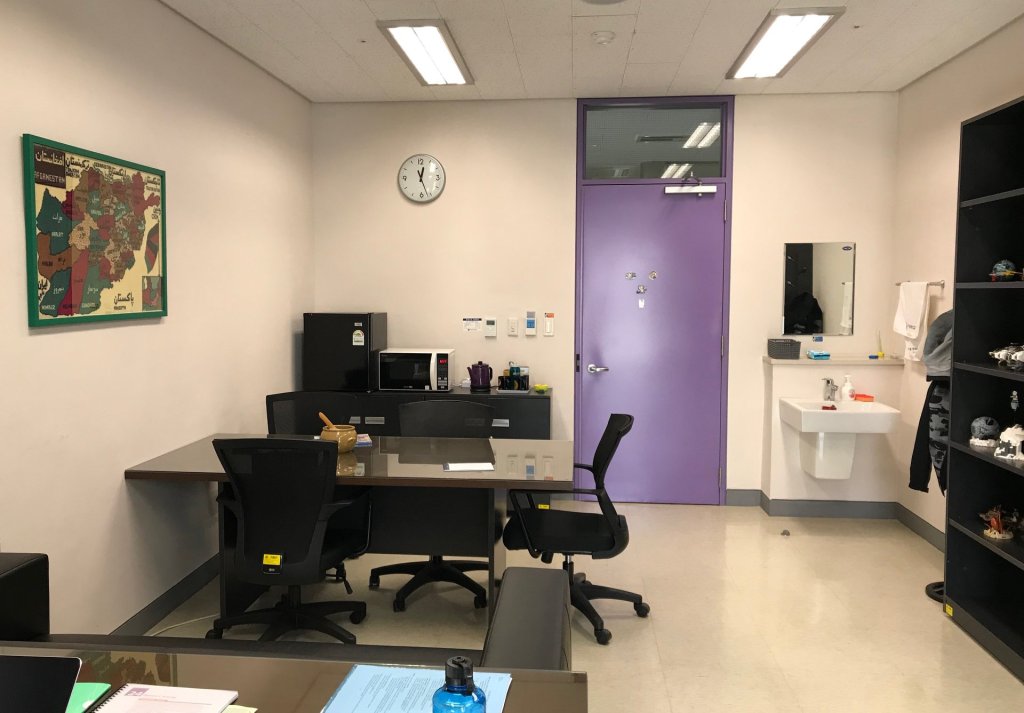
The hallways are quiet. The doors are closed. Koreans often ask me to describe the differences between working in a Korean university and an American university. I see a difference in hallways and doors.
As a professor, I spend much of my time in academic buildings – working in my office, teaching in lecture rooms, and walking in the hallways connecting my office to those lecture rooms. As I walk, I observe the life of the hallway, including the arrangement of the space and the interactions of individuals in that space.(I am an ecologist by training, so I often see things as if they were ecosystems.)
In walking the hallways of different Korean universities, I realize that hallways and doors represent a more important difference between Korean university life and American university life: for me, hallways and doors are a reflection of the professor-student relationship. Professors and students in American universities and colleges have a different type of relationship than in Korean universities.
“My door is always open.” Have you ever heard this American phrase? Business managers and college professors often say it to employees or students. What is the meaning of this phrase? The “door” is the professor’s office door. “Open” gives an invitation: an interaction /relationship with the student is welcomed and wanted. “Always” represents the availability of the professor: when a student wants to talk or to receive help, the professor is available.
In some American colleges/universities, the phrase is literally true: the office doors are kept open. At Brevard College, professors usually keep their doors open when in their offices, unless they are doing something confidential or are under great pressure to keep a deadline. The relationship between professor and student is more casual – for example, some professors allow students to use the professor’s first name, and many professors will “friend” students on Facebook or MySpace. Students can stop by to talk to the professor about classes, career goals, or anything. The hallways seem to be alive with students and professors going in and out of offices. The hallways can be loud or chaotic sometimes, but they are rarely empty.
The hallways are silent. The doors are closed. Students speak more quietly, and they don’t speak to me or say hello. No student drops by my office to chat. For me, these are some of the realities of being a professor in Korea.
Why is it this way? I ask myself that question, and after almost two years in Korea I still don’t have a complete answer. Some of the reasons involve the hallway environment. First, the hallways of Korean universities are not heated in the winter. Second, balconies are often used as smoking locations, which fill hallways with the smell of cigarette smoke. (In the United States, there are cig more rules against public smoking, so smoke in the hallways is not a problem.) Smoke and cold discourage people from keeping doors open. Other reasons for having closed doors involve Korean social structure. Social roles are more defined here than they are in America. The professor/student relationship is more formal and distant.
The differences between American university life and Korean university life are fascinating and challenging. I love to be fascinated and challenged. However, I will always be American at heart, and adjusting to the differences can be difficult and frustrating. I want my office door to be open; I miss having students coming in and out of my office during the day.
So I’ll be American for a moment. For my students or anyone else reading this column, I invite you to visit my office(51313). If you need help with biology, want to practice English conversation, want to help me practice Korean conversation, or just want to introduce yourself, you are welcome and wanted. My door is always open to you. . . . even when it is closed.
Published on 03 May 2010
Sungkyunkwan University Library Archives: https://book.skku.edu/%ec%a0%9c-%eb%ac%b8%ec%9d%80-%ed%95%ad%ec%83%81-%ec%97%b4%eb%a0%a4-%ec%9e%88%ec%8a%b5%eb%8b%88%eb%8b%a4/?pageds=5&p_id=35&k=&c=&div=1
 Science Stories for Today and Tomorrow